
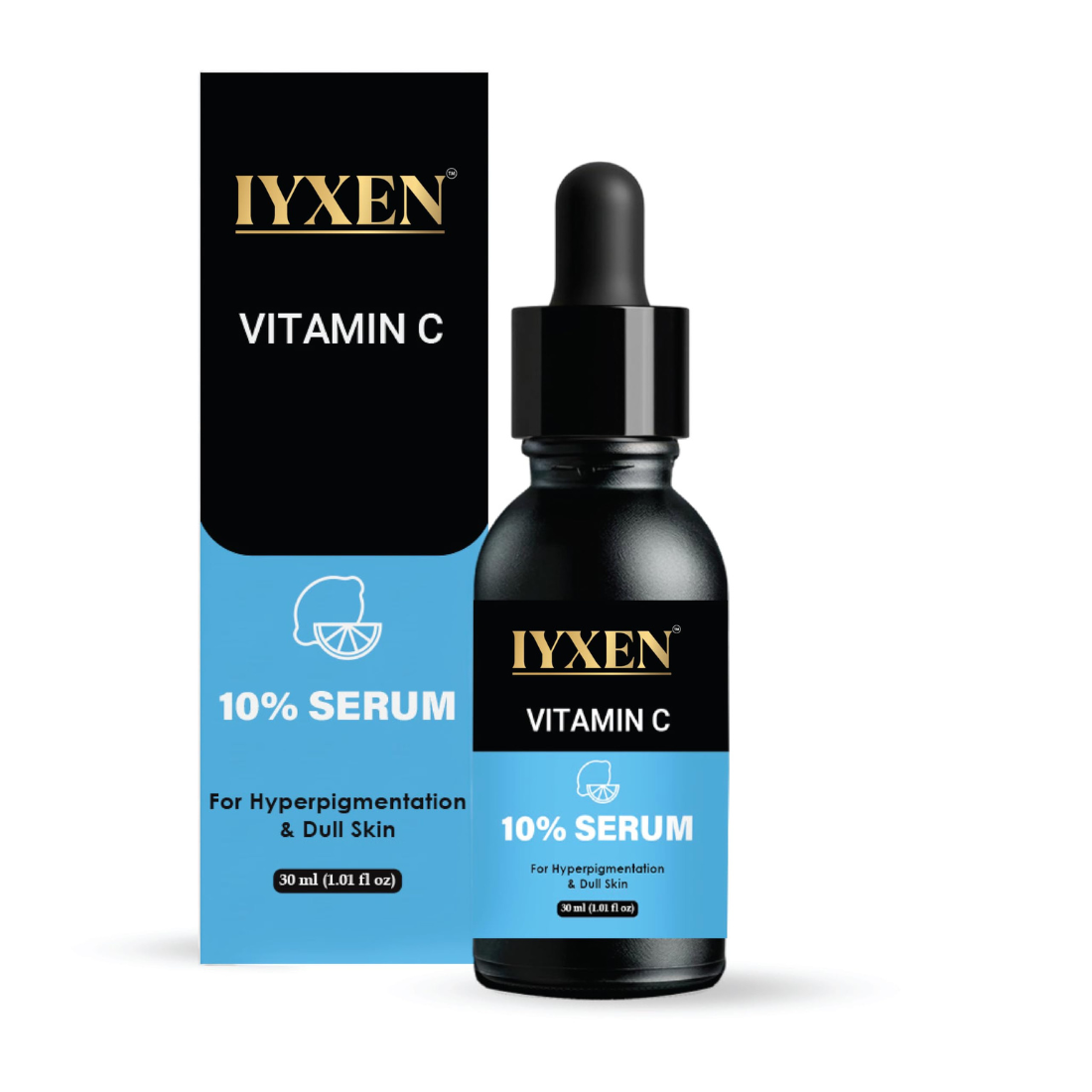
Skincare loves a versus headline. Vitamin C versus niacinamide sounds decisive, but skin rarely needs us to pick a winner. These ingredients do different jobs, overlap in a few useful ways and can live in the same overall routine when the formulas suit your skin.
The more important question is not “which ingredient is better?” It is “what am I trying to improve, and which routine can I repeat comfortably?”
Vitamin C: the antioxidant brightening side
Vitamin C and its cosmetic derivatives are widely used in formulas designed to support radiance and help reduce the appearance of dull, uneven-looking tone. Antioxidant activity is another reason vitamin C has become such a familiar daytime ingredient.
IYXEN's newer Flawless Skin Brightening Face Serum uses 5% 3-O-ethyl ascorbic acid, a vitamin C derivative, alongside 3% niacinamide and 1% kojic acid, with glycerin and botanical extracts. It is a useful example of why the old idea that vitamin C and niacinamide must never appear together is too simplistic: modern formulas can be intentionally built with both.
Niacinamide: the versatile supporting ingredient
Niacinamide appears across products for oily skin, uneven-looking tone and barrier support because it is unusually versatile. Depending on the overall formula, it can fit into routines focused on the appearance of pores, oil balance, post-blemish marks and general skin resilience.
That does not mean higher percentages are always better. The best concentration is the one delivered in a balanced formula your skin tolerates.
Can you use them together?
For many people, yes. The idea that vitamin C and niacinamide automatically cancel each other out comes largely from older formulation concerns that do not translate neatly to every modern cosmetic product. If a single product has been formulated with both, use it as directed rather than trying to separate ingredients that were intentionally combined.
If you own separate serums and your skin is sensitive, you can keep things simple by using one in the morning and one in the evening, or alternating days. There is no prize for fitting every active into the same application.
A simple brightening routine
Morning: gentle cleanse, brightening serum, moisturiser if needed, broad-spectrum sunscreen.
Evening: cleanse, a treatment suited to your main concern, moisturiser. If the daytime serum already contains several brightening actives, your evening routine does not need to repeat every one of them.
Why sunscreen changes the conversation
It is hard to build a sensible routine for uneven-looking tone while treating sun protection as optional. Daily UV exposure can work against your brightening goals, so sunscreen belongs beside your serum rather than in a separate “summer only” category.
How to know if the routine is too much
Stinging, persistent redness, unusual tightness or excessive flaking are not badges of progress. Strip the routine back, allow the skin to settle and reintroduce products gradually. Patch testing is especially useful if your skin is reactive.
Your routine does not need an ingredient champion. It needs products that complement one another, suit your skin and are easy enough to use consistently.
The more useful way to choose
If dullness and antioxidant support are high on your list, a vitamin C-focused formula may appeal to you. If you are also thinking about oil balance, barrier support and the appearance of pores, niacinamide is a useful companion. And if a carefully formulated product gives you both, you do not need to manufacture a conflict that the formula itself has already solved.